
Start Internal: The AI-CS Sequence for Pressure-Testing Your Operating Model

Internal agents first, external agents next. Get the order wrong and the customer absorbs the cost of an operating model the company hasn't yet validated.
Jason Lemkin's headline figure shows up across Lenny Rachitsky's newsletter and Kyle Norton's Revenue Leadership Podcast: 20 agents and 1.2 humans inside the modern post-sale function, the number is an aspiration and a destination. The coverage skips the path from where most customer success organizations sit today to the org chart Lemkin describes.
The path starts with a sequencing rule the coverage misses: deploy AI on the work the customer never sees before deploying AI in front of the customer.
If you're weighing an AI-CS deployment plan, the first move is smaller and lower risk than the pitch in front of you suggests.
The two types of AI agent in CS
Internal AI agents do the work inside the customer success motion: account and usage monitoring, behavior signal tracking, lifecycle automation and workflows, meeting preparation, task management and triage, standard document and report preparation. The output of an internal agent goes to a CSM, an operations lead, or a leadership team member, the customer never sees the work.
External AI agents do the work in front of the customer: a virtual CSM engaging low-touch segments, personalized in-product help during a customer's normal use, just-in-time updates and information delivered to the customer at the moment of need. The output of an external agent reaches the customer without a human filter. The CSM sees it after the fact, if at all.
Both categories produce real value when the operating model underneath is adequate and supports them. The risk profiles split along category lines, and the first move belongs to the internal side.
Why internal agents go first
The sequence holds for three reasons:
The first is containment. Internal agent work happens inside the company’s environment. A misfire produces a wrong report, a missed trigger, a duplicated task, or an escalation routed to the wrong person. The CS team catches the error and corrects forward, with no customer in the loop. The downside shows up as operational friction inside the team, with the customer relationship untouched.
The second is modifiability. Internal agents run against systems the company controls. Iterate the prompts, then adjust the data inputs and triggers. The cycle time on a fix runs in days. External agents embedded in the product or in customer-facing workflow take longer to revise, because every change touches the customer experience and inherits product release cadence and customer change management.
The third is diagnostic value. Internal agents surface weaknesses in the operating model the way a load test surfaces weaknesses in a system. An agent fed by a fractured data foundation produces output the team flags as wrong, and an agent triggering against vague playbooks escalates the same case 12 different ways. An agent generating reports off health scores no one trusts produces work the CS team ignores. The CS team treats each failure mode as a diagnostic signal, mapping it to the dimension of the operating model where improvement has to land before external agents reach the customer.
What internal agents surface across the 7 maturity dimensions
Our CS Maturity Assessment scores the operating model across seven dimensions. Internal agent deployment puts immediate stress on three of them, and the stress helps diagnose.
Data and Customer Intelligence
Internal agents read the data foundation, health scoring, relationship intelligence, and the reporting layer. A weak data foundation produces wrong inputs at machine speed. An agent monitoring account health surfaces every quality issue in the underlying scoring model inside its first week. The signal arrives loud and fast, at no operational cost.
Enablement and Operations
Internal agents run against the tech stack, the playbooks, the capacity model, and the governance layer. An agent automating a lifecycle workflow exposes the playbook gaps and undefined ownership boundaries, along with the governance questions no one had to answer when humans ran the work by hand. Internal deployment turns implicit operating decisions into explicit ones.
Engagement and Revenue Outcomes
Internal agents preparing renewal briefs, expansion-readiness summaries, or executive review packs surface the quality of the upstream motion. An agent producing a renewal brief from a fractured account record produces a brief the renewal owner has to rewrite. An agent preparing an expansion-readiness summary surfaces whether whitespace mapping exists at all. Internal deployment puts the operating model's weak points in plain view.
Why external agents go second
External agent misfires happen in front of the customer in real time, and the trust damage dwarfs anything an internal error produces.
A wrong internal report costs the team a few hours of rework. A virtual CSM sending a customer an incorrect renewal date, a fabricated commitment, or a confident answer to a question the agent should have escalated costs the customer relationship and the executive sponsor's confidence in the platform. Recovery from a public misfire takes months and burns the next several customer-facing interactions to rebuild trust.
External agents also embed deeper into the core customer experience. A virtual CSM working a low-touch segment becomes part of how the customer experiences the brand. Changing the behavior of an external agent after rollout is slower and more visible than changing an internal one. The decision is closer to a product release than to a workflow tweak. A/B tests still fit, but treat the implementation as a beta release.
External deployment belongs to a company that has absorbed the diagnostic from internal deployment and completed a full assessment of its operating model maturity. Run the operating model through internal first, fix what surfaces. Then ship external once the dimensions feeding the customer-facing motion score at the maturity level the deployment requires.
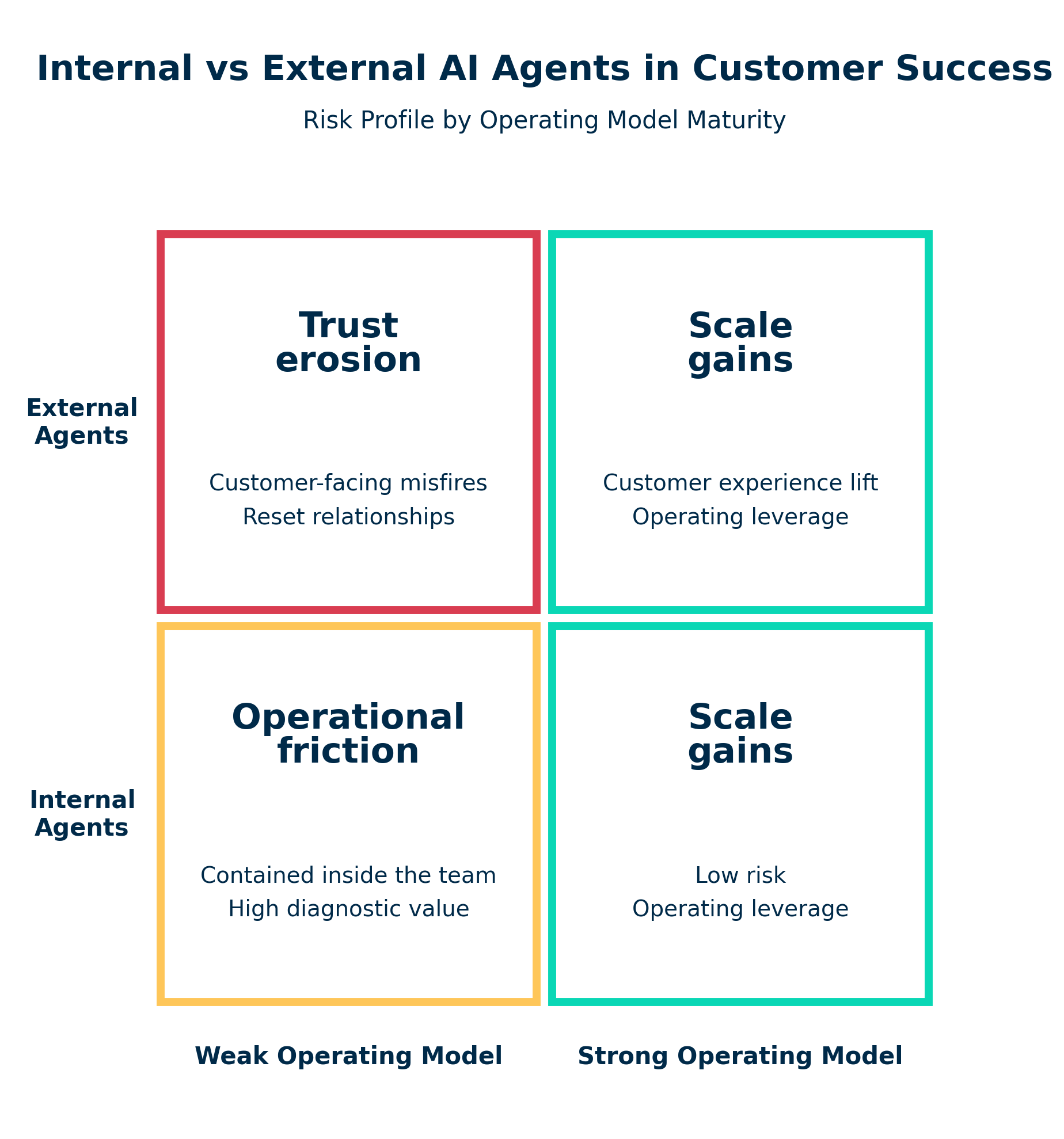
Risk profiles based on the Success Calibrators CS Maturity Assessment, scored across 7 dimensions with a 20-element AI Readiness layer.
The NRR levers under the sequence
Net Revenue Retention is the compounding output of three financial levers: retain (kill logo churn), protect (kill contraction and downsell), and expand (capture upsell and cross-sell). Every motion in customer success has to serve one of the three, with a leading indicator attached.
Internal-first sequencing serves all three levers without putting any of them at risk in front of the customer.
Retain: internal agents monitoring usage patterns surface adoption cliffs and value-realization gaps inside the team. Save plays trigger from internal signal, so the customer sees a CSM showing up early with context while the agent stays out of sight.
Protect: internal agents preparing contraction-risk briefs and renewal whitespace analysis give the team time to multithread, expand the sponsor map, and rebuild the value case before the customer's procurement team opens the seat reduction conversation. Defensive moves stay private until they show up as a strong renewal.
Expand: internal agents track which customers have realized value against their original business case and surface the other goals each customer has named along the way. The CSM uses the read to nurture the account, plant seeds against the next opportunity, and ripen the conversation so the customer arrives at the expansion table ready. This is the work most expansion motions skip, the gap between value realized and value monetized where NRR leaks. Once the internal version proves out, external agents extend the ripening play to the low-touch segment without exposing the lever to model risk.
External deployment, sequenced after the operating model proves out internally, scales the same three levers without inheriting the diagnostic surface area.
How to know your operating model is ready for external
Phase 1 of our Revenue Success Program is the diagnostic. It produces five outputs that anchor the blueprint to elevate your internal motions and accelerate NRR growth.
Maturity scores across the 7 dimensions and 130-plus elements. A ranked read of where the customer success operating model is strong, where it leaks, and where the next investment dollar returns the most.
An AI Readiness score from a separate 20-element layer evaluated across every dimension. Where AI strengthens the operating model today, and where the company leaves capability on the table.
NRR Opportunity Sizing across both halves of NRR. The Churn Tax sizes the retention side at 1.5 to 2.5x reported churn. The Expansion Gap sizes the growth side. Together they produce the full revenue exposure the operating model is not capturing.
Prioritized recovery vectors, sequenced by NRR return.
The NRR Improvement case and Growth Blueprint inputs. Year-1 NRR target and multi-year trajectory.
A leadership team sitting on those five outputs has the structured read on which dimensions support which type of AI agent today, which dimensions need investment before external deployment makes sense, and the evidence to decide.
Where to start
Pick the internal agents easiest to deploy and easiest to modify: account and usage monitoring, lifecycle automation, meeting prep, task triage, standard report generation. Ship them against the operating model in place today, with the explicit objective of surfacing where the model holds and where it breaks. Use the resulting friction to inform the operating model investment, then move to external agents with a clean read on which dimensions are ready and which dimensions aren't.
The Revenue Success Program Phase 1 diagnostic gives you a deeper and broader assessment of your current operating model, and shows where AI strengthens it today and where investment has to land before external deployment goes live.
Learn more about our Revenue Success Program →