
The Churn Tax: The Full Cost Your Churn Rate Hides

Your churn rate shows one-third of the real cost, and leadership teams are making capital allocation decisions on incomplete math.
Companies report churn as a percentage, boards see it, CFOs budget around it, and leadership moves on. The number captures one layer of the real cost. The full financial impact of revenue churn runs 1.5-2.5x the figure most leadership teams believe they're paying.
We call this the Churn Tax: the total economic drag of revenue churn on your business, measured in real dollars instead of a percentage on a dashboard.
The Three Layers of the Churn Tax
Most companies track Layer 1 and stop there.
Layer 1: Lost recurring revenue. This is the number on the board deck. The ARR your customers didn't renew. At a $300M company with 9% churn, it's $27M per year. The CFO budgets around it, the board reviews it, and the conversation moves to the next slide. That umber covers one-third of the real cost.
Layer 2: The organizational cost to replace lost revenue. When a customer churns, the sales team has to find, sell, close, and onboard a replacement, burning sales capacity, commission, T&E, and management overhead. Every dollar of churned revenue costs roughly $0.34 in sales resources to backfill. At $300M ARR, the company spends $9.1M per year in sales effort replacing revenue it already had.
One-third of your sales budget runs on a treadmill.
Layer 3: The downstream revenue you'll never collect. A churned customer takes future expansion with them: the upsells and the higher renewal price points. Those accounts would have expanded 8% a year. Over the two-year window it takes to replace them, you give up $4.4M in expansion you'd otherwise have booked.
Churn reports miss this number because it never existed on paper, even though the revenue was real.
The Real Number
Add those three layers together and a $300M company with a 9% churn rate is losing $40.5M per year, well past the $27M on the board deck.
Over 3 years, with a growing ARR base, the cost compounds to $132M.
The gap between the number leadership sees ($27M) and the full economic cost ($40.5M) is 50%. That gap is the Churn Tax, and it grows with your ARR.
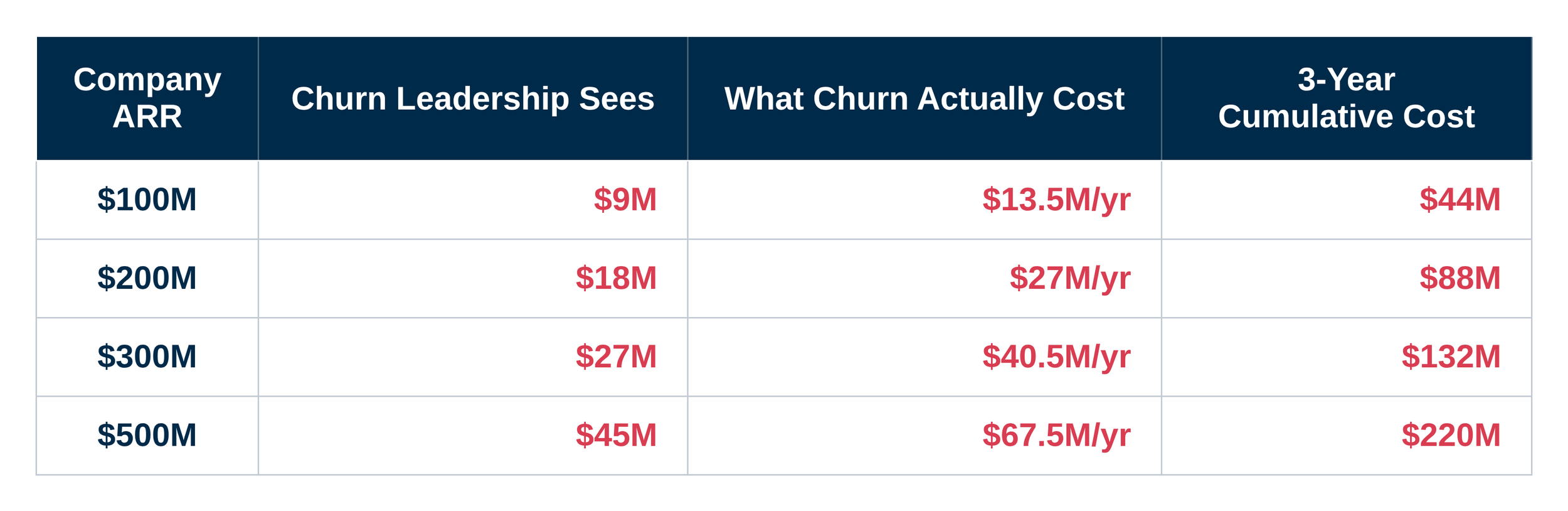
Based on a 9% revenue churn rate and conservative assumptions. 3-year cumulative accounts for compounding at 9% net ARR growth.
A Capital Allocation Problem Inside Your CS Metrics
When a CEO looks at the sales budget and sees $27M in bookings effort going to replace churned revenue, the company has a resource allocation failure the CS team didn't create and can't fix alone.
Product decisions affect adoption, sales practices set wrong expectations, support teams operate without customer health data, and onboarding processes delay time-to-value. Each one contributes to churn, sits outside the CS team's control, and shows up in the CS team's retention number.
Companies figuring this out treat Customer Success as a revenue protection investment with measurable ROI, while the rest keep pouring money into acquisition to replace revenue they keep losing.
The Fix Has a Calculable ROI
A mature post-sale revenue engine reduces churn, recovers downstream value, and builds an expansion motion on top of the retained base.
At $300M ARR, reducing churn by 3 percentage points (9% to 6%) and lifting expansion from 8% to 12% generates $24.7M per year in recovered revenue by Year 3. Against an incremental CS investment of $8.9M, the return exceeds 3x.
The investment breaks even in Year 1 and compounds from Year 2 forward. It lifts NRR from 99% to 106%, which raises the revenue multiple a buyer will pay at exit.
On a $300M company, the difference between a 99% NRR (8x multiple) and a 106% NRR (10x multiple) is $1.29B in enterprise value.
It's the highest-leverage revenue investment a growth-stage company has, and it sits in the post-sale org.
Calculate Yours
The numbers above use conservative assumptions modeled below industry medians. Your company's Churn Tax depends on your specific ARR, churn rate, expansion rate, and sales cost structure.
We run a custom Churn Tax Diagnostic calculating the exact number for your business. In 4-6 weeks, you get the total cost, a maturity assessment, and a board-ready investment case with ROI projections.